
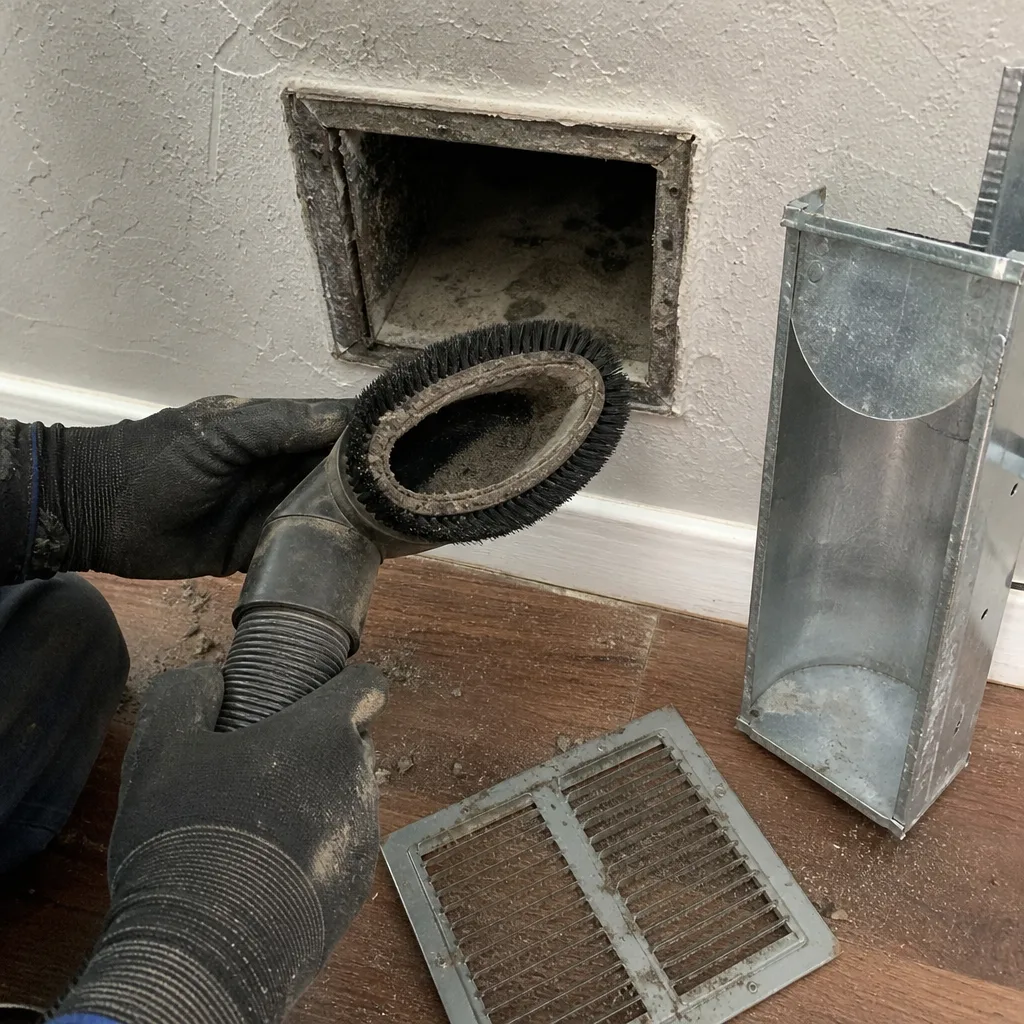
Last updated November 16, 2026
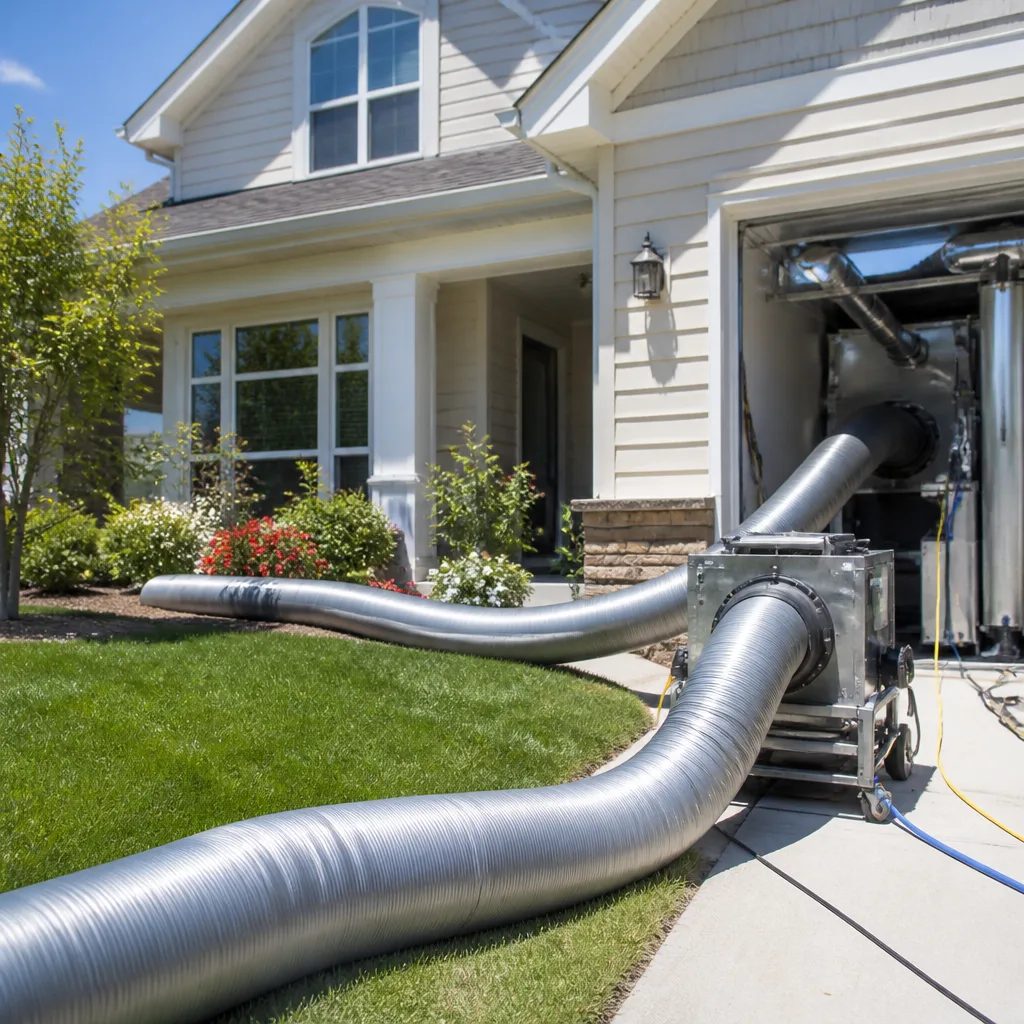 Whole-home duct cleaning
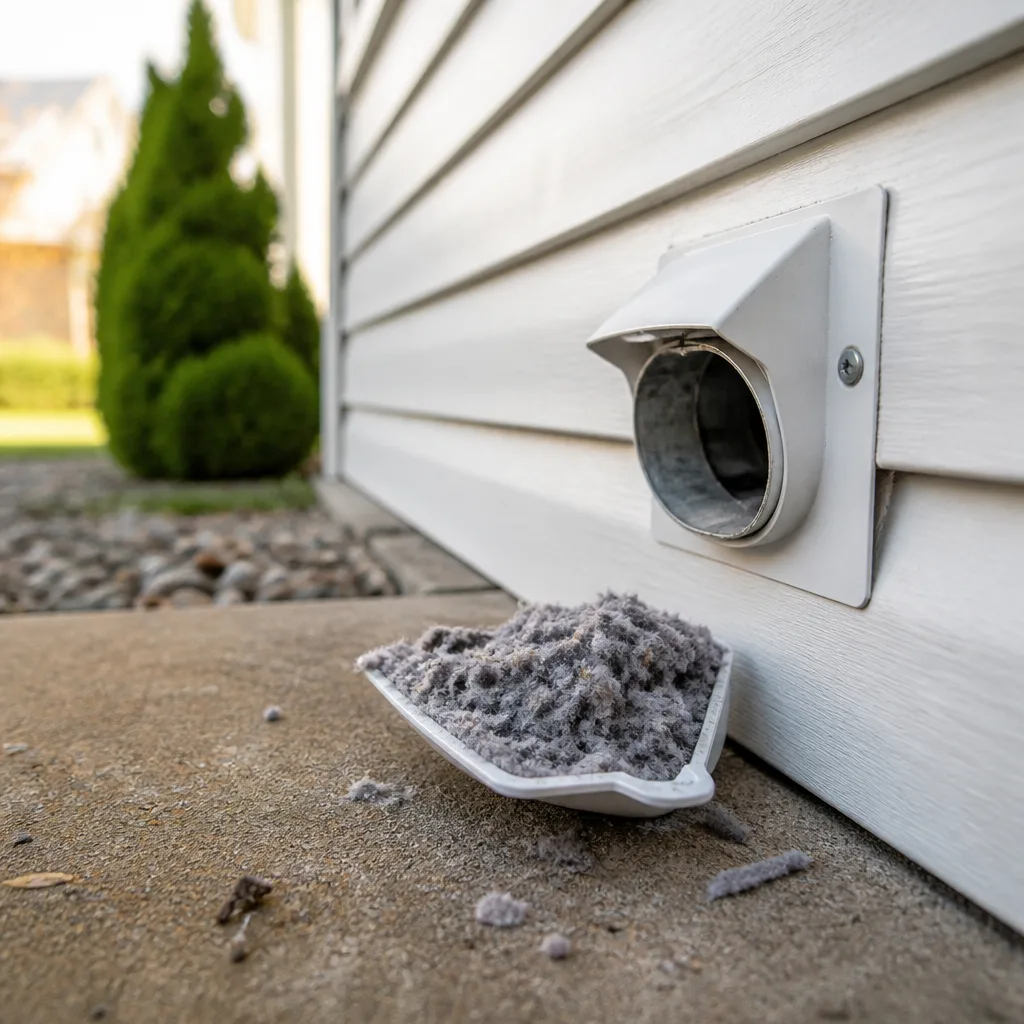 Dryer vent cleaning
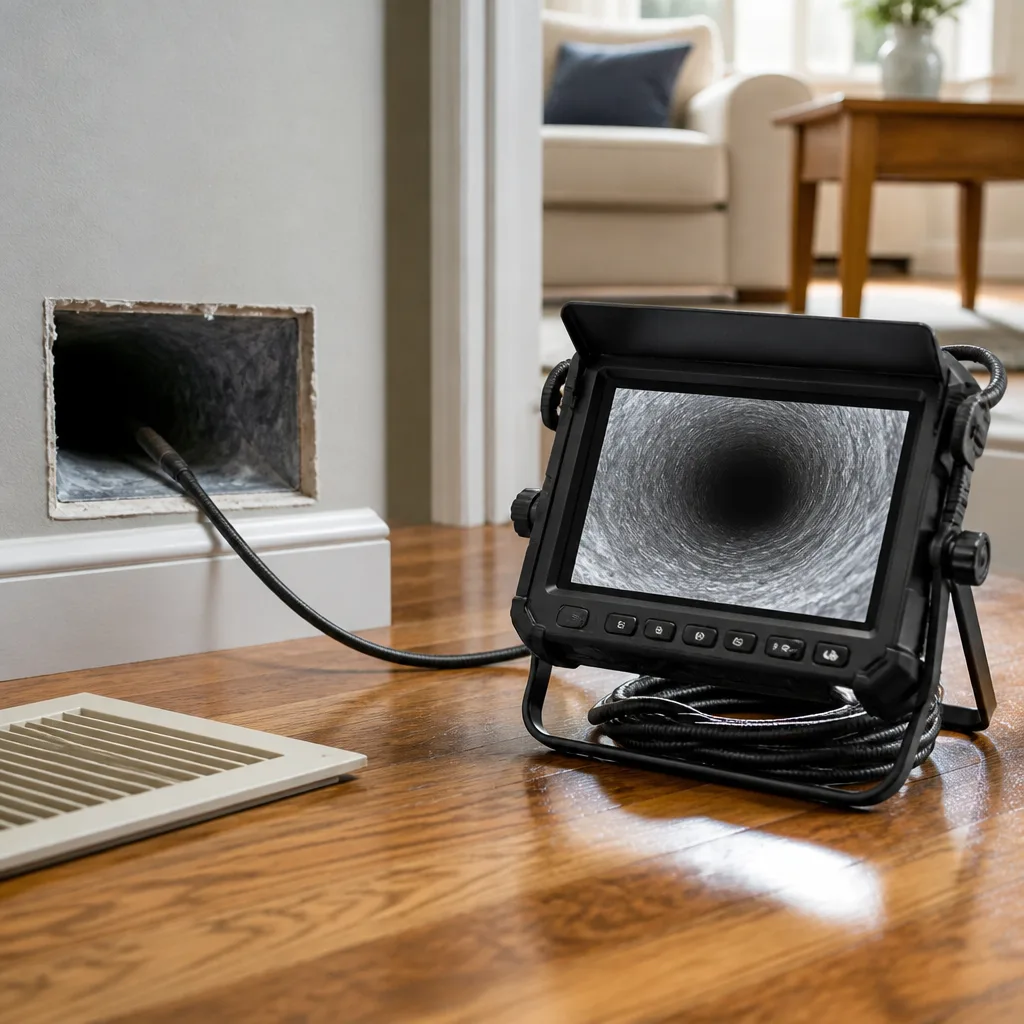 Camera inspection
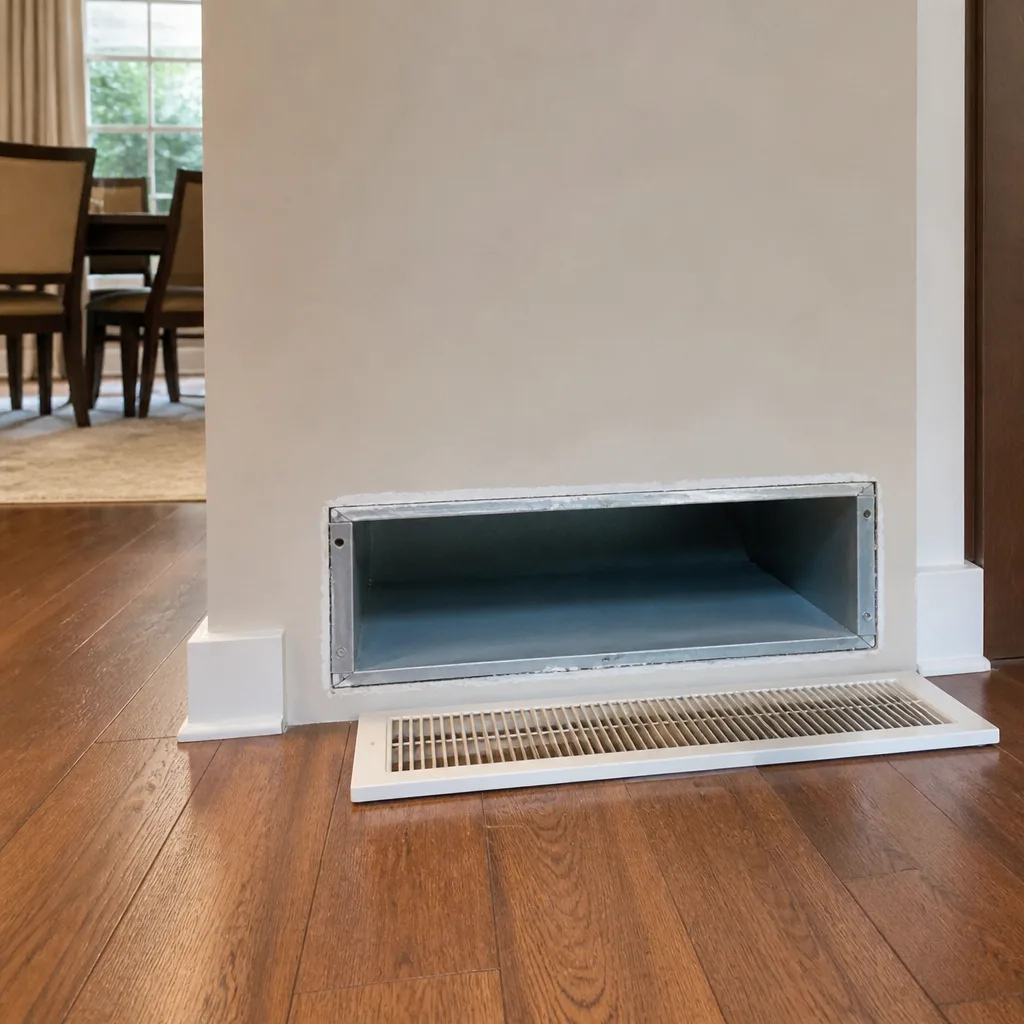 Sanitizing & deodorizing
Whole-system duct and dryer vent check with before-and-after photos - you see exactly what came out of your vents
That "$99 whole-house special" is a bait ad - the real number appears once they are in your hallway, or the "clean" is a shop-vac at the register. We photograph the inside of your ducts before and after instead.
The Complete Guide to Air Duct Cleaning in Odessa
Most homeowners think of duct cleaning as a seasonal chore, something you pencil in next to changing filters. That framing gets the priority backwards. In Odessa, your duct system runs through the toughest operating conditions in the country, and the dust it moves never stops. Odessa averages over 260 sunny days a year, which sounds great until you realize your HVAC runs nearly year-round pushing West Texas dust – caliche, silica, and oilfield-adjacent particulates – through every register in your home. This guide treats the duct system as infrastructure, not an afterthought. We’ll cover why contamination builds faster here than national guidance assumes, what a real full-system inspection includes, and how to tell source removal from a surface wipe-down.
Quick Answer
Air duct cleaning in Odessa should be a full-system job: mechanical source removal of debris from the supply and return ducts, plenum, and air handler using professional-grade rotary brush and HEPA vacuum equipment, plus an inspection for leaks and compromised joints. A single-pass vacuum on the visible vents is not cleaning; it’s a surface pass that leaves the settled caliche dust exactly where it does its worst damage. The right scope is set by the condition of the system, not by a vent count.
Styles & brands we work with
- Whole-home duct cleaning
- Dryer vent cleaning
- Camera inspection
- Sanitizing & deodorizing
Table of Contents
- Why Odessa’s Air Quality Makes Standard Duct Cleaning Insufficient
- What a Full-System Inspection Actually Covers
- Source Removal vs. Surface Cleaning: The Equipment That Tells Them Apart
- How Duct Leakage in Permian Basin Homes Compounds Contamination
- What a Legitimate Job Looks Like Start to Finish
- Dryer Vent Cleaning: The Safety Side of the Same System
- How Often Ducts Really Need Cleaning in Odessa
- How to Choose a Duct Cleaning Company in Odessa
Why Odessa’s Air Quality Makes Standard Duct Cleaning Insufficient
National duct-cleaning guidance assumes a typical American climate with a heating season and a cooling season. Odessa doesn’t fit that model. The system runs hard for most of the calendar, and when it runs hard it pulls in whatever is suspended in the outside air.
That outside air has a specific character here. Caliche is the calcium-carbonate hardpan that underlies much of the Permian Basin, and when it dries and breaks down it produces a fine, alkaline dust that coats surfaces and clings to anything with a slight electrostatic charge. Blowing around during construction, land clearing, and wind events, it settles into return grilles and rides into supply runs. Silica dust from the surrounding desert ground adds another very fine fraction that household filters catch less of than residents expect.
Layer in proximity to oilfield activity. The Permian Basin is the busiest oil and gas region in the country, and the particulates associated with heavy equipment, flaring, and road traffic drift into residential neighborhoods on the prevailing wind. Homes near active well pads, tank batteries, and heavy truck routes accumulate the finest of this material, and fine particles are the hardest to remove once they settle inside a duct.
Finally, low humidity. Odessa runs dry, and dry air keeps dust airborne far longer than humid air would. Material that would settle in a wetter climate keeps circulating through the system and re-coating the interior of the ducts on every cycle. The practical result: Odessa duct systems can reach a contamination level that would take far longer to hit in a milder, wetter part of the country.
What a Full-System Inspection Actually Covers
Most residential quotes are built around a vent count. A technician walks the house, tallies the registers, and multiplies. That method tells you almost nothing about the condition of your system, because the dirtiest parts of a duct system are almost never the registers.
A real inspection opens up the parts of the system the vent count misses:
- The plenum. The large box where the air handler connects to the duct trunk. It’s a wide, low-velocity chamber, and it collects settled dust in a way the narrower runs don’t.
- The air handler cabinet. The blower wheel and evaporator coil sit inside. A caked coil restricts airflow across the whole system and can push contamination downstream.
- Return boxes and return trunks. Return air is where most debris enters, and return-side interiors often show heavier accumulation than supplies.
- Access points and duct joints. Every joint, boot, and seam is a potential leak. When we inspect, we’re looking for physical separation, disconnected flex duct, and crushed runs.
- Register interiors and boot connections. The short boot between the duct and the register is a frequent collection point that a superficial cleaning skips entirely.
The inspection is what sets the scope. Two homes in the same Odessa neighborhood with the same square footage can need very different work, and the only way to know which is which is to look inside the system. A company that quotes from the driveway without opening anything is guessing, and you’ll pay regardless.
Source Removal vs. Surface Cleaning: The Equipment That Tells Them Apart
The distinction between real duct cleaning and a cosmetic pass comes down to one question: does the debris leave the system, or does it just get moved around?
Surface cleaning uses a shop vacuum on the register openings, sometimes a handheld brush on the visible ductwork. The dust that has bonded to the interior of the ducts, the settled caliche in the plenum, and the material trapped in the boots stay right where they were. Source removal is the industry’s term for physically dislodging and containing all of that debris and extracting it from the system.
You can tell which approach you’re getting by the equipment on the job:
- Rotary brush systems. Rotobrush is the professional standard for mechanical duct cleaning: a rotating brush whip that travels the full length of each run, scrubbing the interior wall and loosening bonded debris back toward the collection point. A vacuum alone cannot scrub.
- HEPA-rated negative pressure vacuum. Nikro HEPA extraction pulls the dislodged material out under high-efficiency filtration and holds the system under negative pressure during the job so airborne debris doesn’t escape into the living space. A shop vacuum does neither.
- Containment capability. Abatement Technologies equipment signals that the crew is set up for containment-level work, the same class of tooling used on serious indoor air quality and remediation jobs. It’s above typical residential duct-cleaning scope, and it matters most in homes near an active renovation or with a system that has been run with a failed filter.
We run Rotobrush and Nikro systems on every duct job, and we keep Abatement Technologies on hand for the jobs that need it. More importantly, we also handle air duct cleaning alongside duct repair, so when the inspection finds a failed joint or a crushed run, the fix happens on the same visit rather than waiting on a second contractor.
One more equipment signal: familiarity with the components inside the system. We work with Honeywell and Aprilaire equipment, the whole-home air quality brands most often found on Odessa system controls and humidifiers. Knowing how those components interact with airflow means we can clean around them without disturbing settings or sensors that weren’t part of the job.
How Duct Leakage in Permian Basin Homes Compounds Contamination
A sealed duct system delivers conditioned air only where it was designed to. An unsealed system delivers something else entirely. Duct leakage is common in Permian Basin construction, particularly on older homes and on any system with flex duct run through the attic, and it’s a contamination problem even when everything inside the ducts looks fine.
Here’s the mechanism. In a typical attic installation, the return side of the duct system runs at negative pressure relative to the attic. Any gap or disconnected joint on the return draws attic air into the system. That attic air carries insulation fibers, the fine dust that settles on rafters and decking, and in some homes pest debris. It doesn’t get filtered out because it enters downstream of the filter. Every time the blower runs, your supply registers deliver it into the house and onto the coil.
The same pattern happens on crawlspace systems, and it’s especially pronounced in Odessa because the system runs so many hours a year. A leak that would deliver a modest amount of attic air in a mild climate delivers a lot of it here.
This is why a cleaning job that ignores the physical integrity of the ductwork is incomplete. Cleaning a leaky system just gives the leaks a clean surface to re-contaminate. When we inspect, we’re looking at duct integrity at every accessible joint and connection. Where a run is separated, crushed, or torn, we repair or re-connect it before we finish. Cleaning and repair are the same job, done by the same team.
The fixing matters for comfort as much as for air quality. Leaks on the supply side dump conditioned air into the attic, which the blower then has to make up from elsewhere. Those are dollars running into the rafters, and they add up quicker in a climate where the cooling load is most of the year.
What a Legitimate Job Looks Like Start to Finish
If you’re going to pay for a full-system cleaning, you should know what the process should look like. The sequence matters as much as the equipment, because containment failures happen in the wrong order.
- Inspection and scope agreement. The technician opens the system, checks the plenum, air handler, returns, and accessible runs, and writes out what will be cleaned and what, if anything, needs repair. The price is agreed before work starts.
- Pre-cleaning setup. The system goes under negative pressure with the HEPA vacuum connected to the main trunk. Registers are sealed at the openings so debris has one route out: back through the vacuum, not into the room.
- Mechanical agitation, run by run. The rotary brush travels each supply and return run from the trunk to the boot, then back again. The plenum and air handler cabinet get separate attention. This is the longest part of the job, and rushing it is where a cheap cleaning saves money.
- Component cleaning. The blower wheel and coil get cleaned as part of the cabinet scope. A clean duct system feeding a dirty coil is a half-done job.
- Repair scope, if needed. Disconnected, crushed, or leaking joints get repaired while the system is open and accessible.
- Post-clean verification. Before the equipment comes down, we verify with the camera that each run is clear and inspect for any debris we loosened but didn’t fully extract.
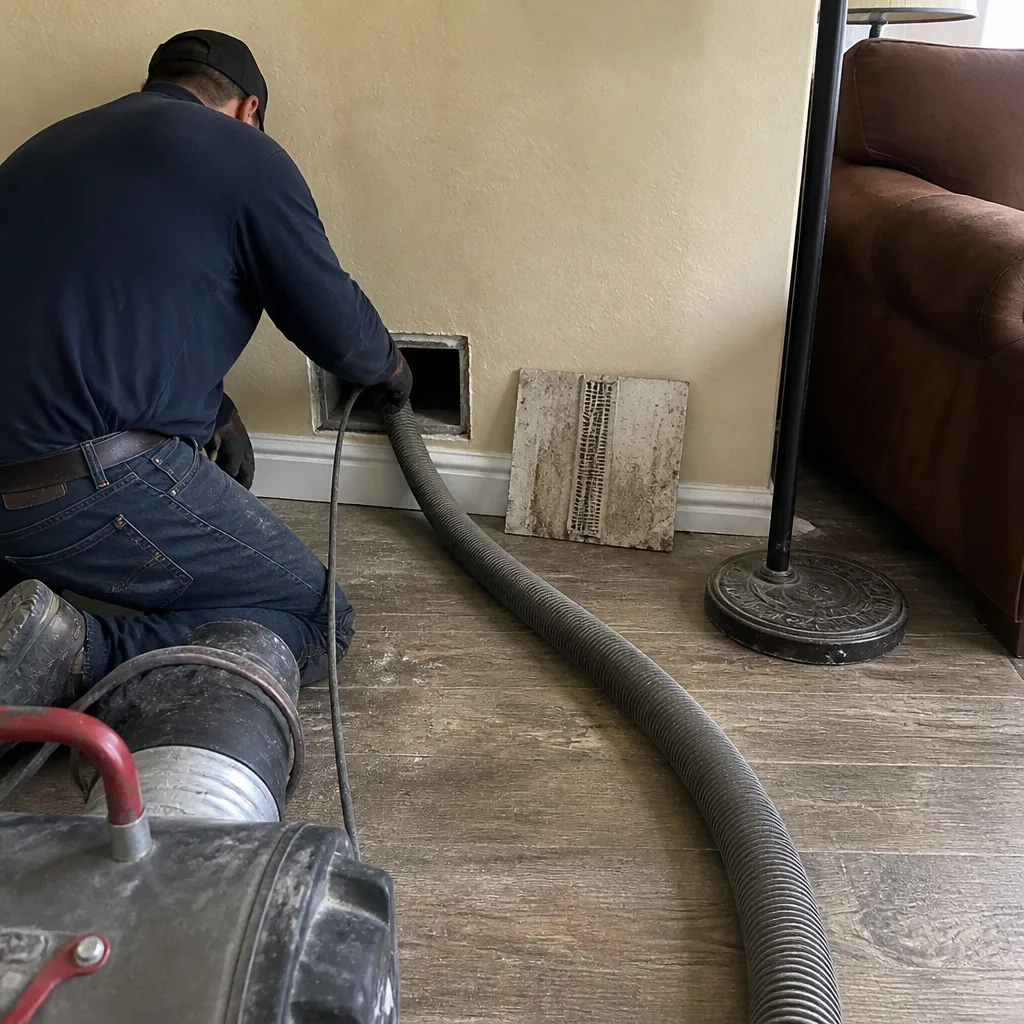
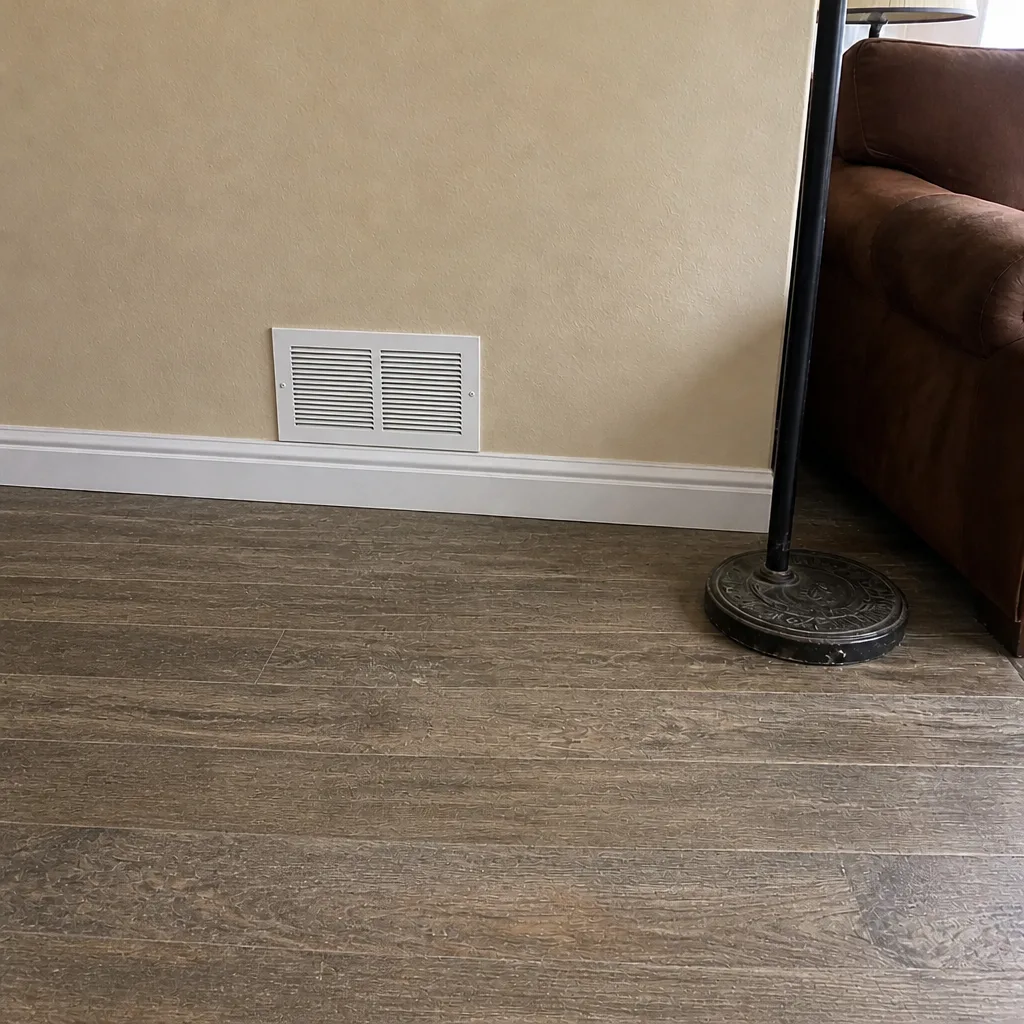
- Before-and-after photos. The interior of the ducts photographed before cleaning and after, shared with the homeowner. If the job was done, the photos show it. Ask for them on any quote you receive.
Note what’s not on that list: a price per vent. The scope here is set by the system, the length of the runs, and the condition of the ductwork. A home with long flex runs and a leaky return trunk is a different job than a compact ranch with tight metal duct. One flat price per system, agreed before work starts, is a fairer arrangement than a low coupon that becomes a large invoice once the technician is on site.
Dryer Vent Cleaning: The Safety Side of the Same System
Duct cleaning and dryer vent cleaning are different jobs with different failure modes. Lint buildup in a dryer vent is a genuine fire risk, and it’s one most homeowners never look at.
The mechanism is simple. Lint that escapes the dryer’s own filter accumulates inside the vent run. A partially blocked vent extends drying times, which means the dryer runs longer and hotter, which produces more lint. The cycle accelerates. In a town where the system runs year-round and much of it is installed through attic or wall cavities, a vent can be heavily loaded and show almost no external sign.
Our dryer vent cleaning uses the same professional extraction equipment as the duct work. The vent is cleared end to end, and the dryer’s exhaust is verified. It’s a short job that addresses a fire risk most homeowners overlook, and if your dryer is taking noticeably longer than it used to, the vent is the first place we look.
How Often Ducts Really Need Cleaning in Odessa
There’s no universal number, and any company that gives you one without inspecting your system is selling a schedule, not a service. The honest answer is that frequency depends on the home and the system.
Factors that push toward cleaning sooner in Odessa:
- Nearby oilfield activity, heavy truck traffic, or active construction on the same block.
- A recent renovation inside the home, which sends drywall dust and sawdust through the returns.
- An older home with flex duct, poorly sealed attic penetrations, or a return line installed in the attic.
- Smokers, pets, or household members with allergies or respiratory conditions.
- A system that has been run with a failed or wrong-sized filter for an extended period.
- Visible dust streaks at registers, musty odors on startup, or persistent dust accumulation on furniture soon after cleaning.
For most Odessa homes, an inspection every couple of years and a cleaning when the inspection shows accumulation is a reasonable rhythm. Homes in the heavier-dust zones around the active parts of the basin often need a closer cadence. The point of the inspection is to make the call based on the condition of the system, not a preset calendar.
How to Choose a Duct Cleaning Company in Odessa
The duct cleaning industry has a well-earned reputation problem: the coupon price that expands once the technician is in the driveway. Choosing well is mostly a matter of asking the right questions before you book.
- Ask what equipment they run. If the answer is a shop vacuum and a brush, you’re getting a surface pass. A rotary brush system and a HEPA-rated vacuum are the baseline for real cleaning.
- Ask whether they’ll inspect before they quote. A vent count from the doorstep is not an inspection. If the plenum, air handler, and returns aren’t opened, the quote isn’t based on the job.
- Ask about repair capability. A company that can clean but can’t fix a separated joint or a crushed run will hand you the problem back.
- Ask for before-and-after photos. Not stock photos. Your photos, from your ducts.
- Ask about pricing structure. One flat price per system, agreed before work starts, is a fundamentally more honest arrangement than a per-vent price or a promo figure that low-anchors the conversation.
These are also the questions that separate the trade from the coupon. A technician with a rotary brush and a HEPA vacuum is doing a physical job that takes time. A crew with a shop vacuum and a two-minute pass is doing something else, and the photo evidence is hard to fake.
Common Mistakes to Avoid
- Judging a quote by the price per vent. A low per-vent figure is a lead-in. The scoped full-system job is priced per system, and the number should reflect the system’s condition, not a vent count.
- Accepting a cleaning without an inspection. If the plenum, air handler, and return boxes are never opened, the quote is a guess. Cleaning without inspecting may miss a repair that turns a clean system back into a dusty one.
- Cleaning a leaky system without fixing the leaks. A return duct that draws attic air will re-contaminate the ducts as soon as the job ends. Duct integrity is part of the cleaning, not a separate upsell.
- Ignoring the dryer vent. Lint buildup is a fire risk, and it’s silent. If your dryer runs longer than it used to, the vent is where the problem lives.
- Getting the work done during or right after a renovation without a post-renovation pass. Drywall dust and sawdust move straight into the returns. Cleaning right after the paint is dry is a wasted job; wait for the dust to settle or plan a cleaning once the project is done.
- Not asking for before-and-after photos. Without them, you have the technician’s word. With them, you have evidence.
- Running a dirty filter to save a few dollars. A clogged filter starves the system and forces dust into the coil. Filters are the cheapest component of the system and the one that does the most protection.
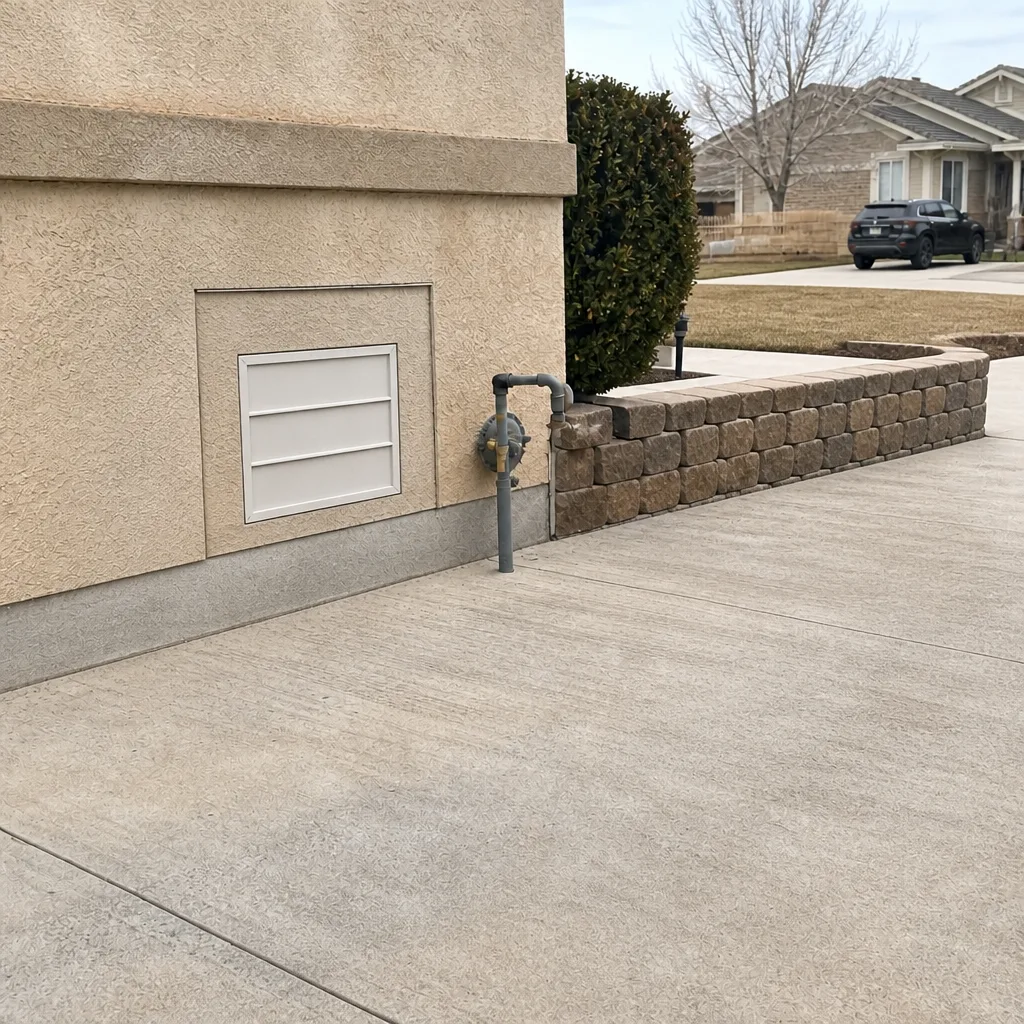
See the difference
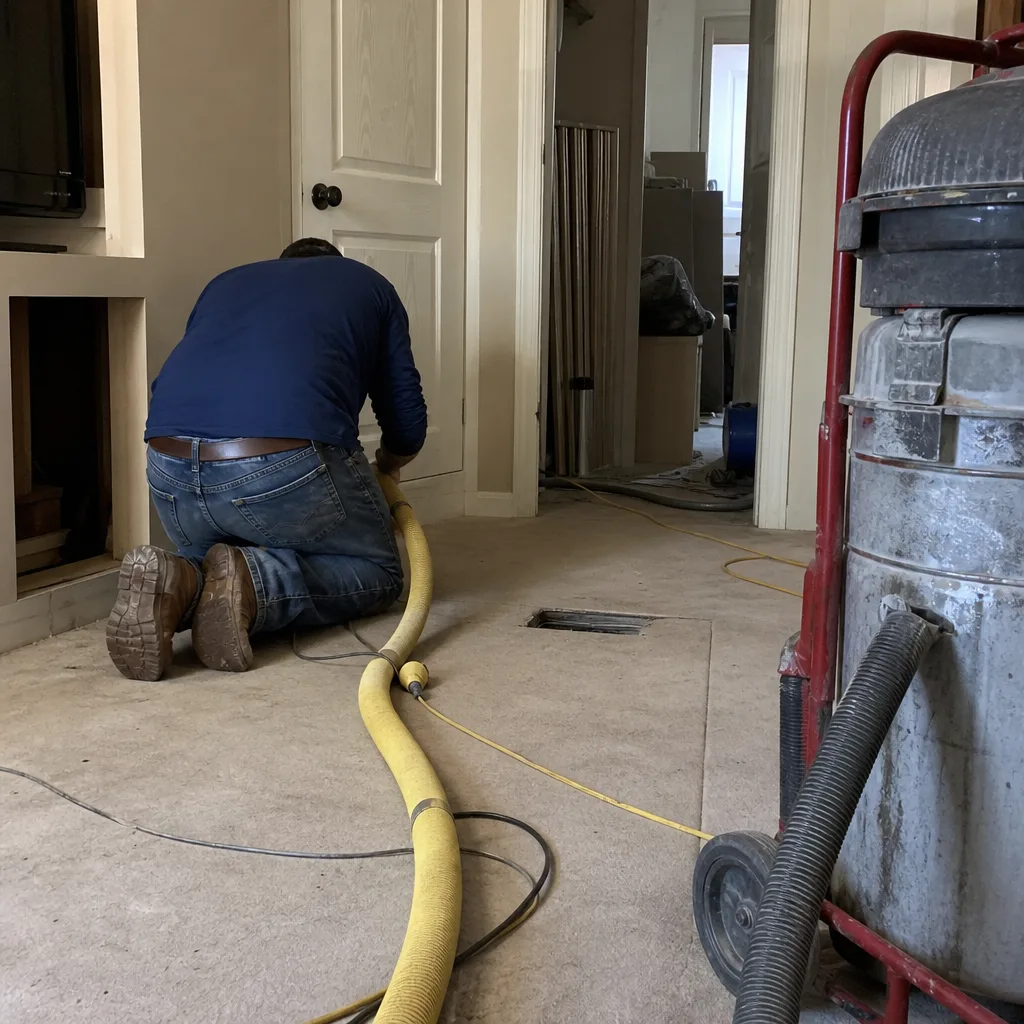 Before
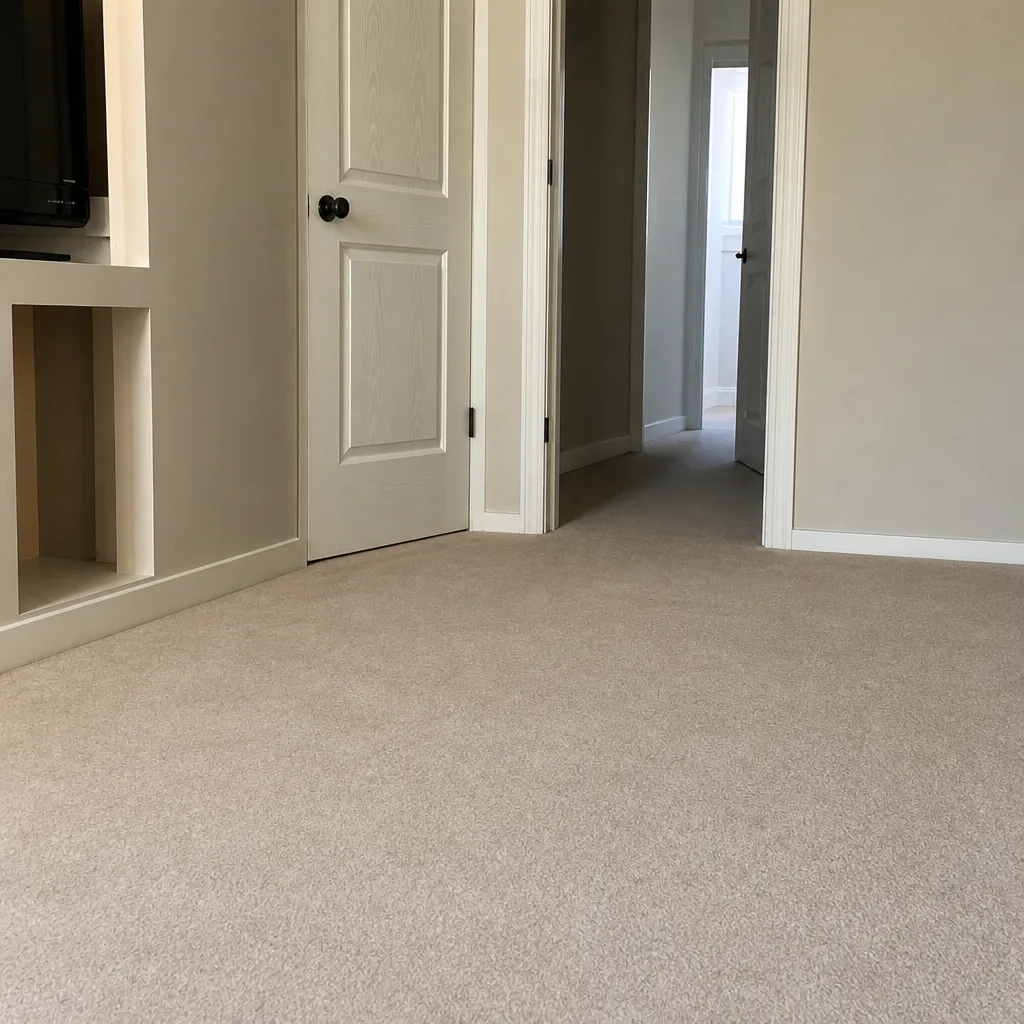 After
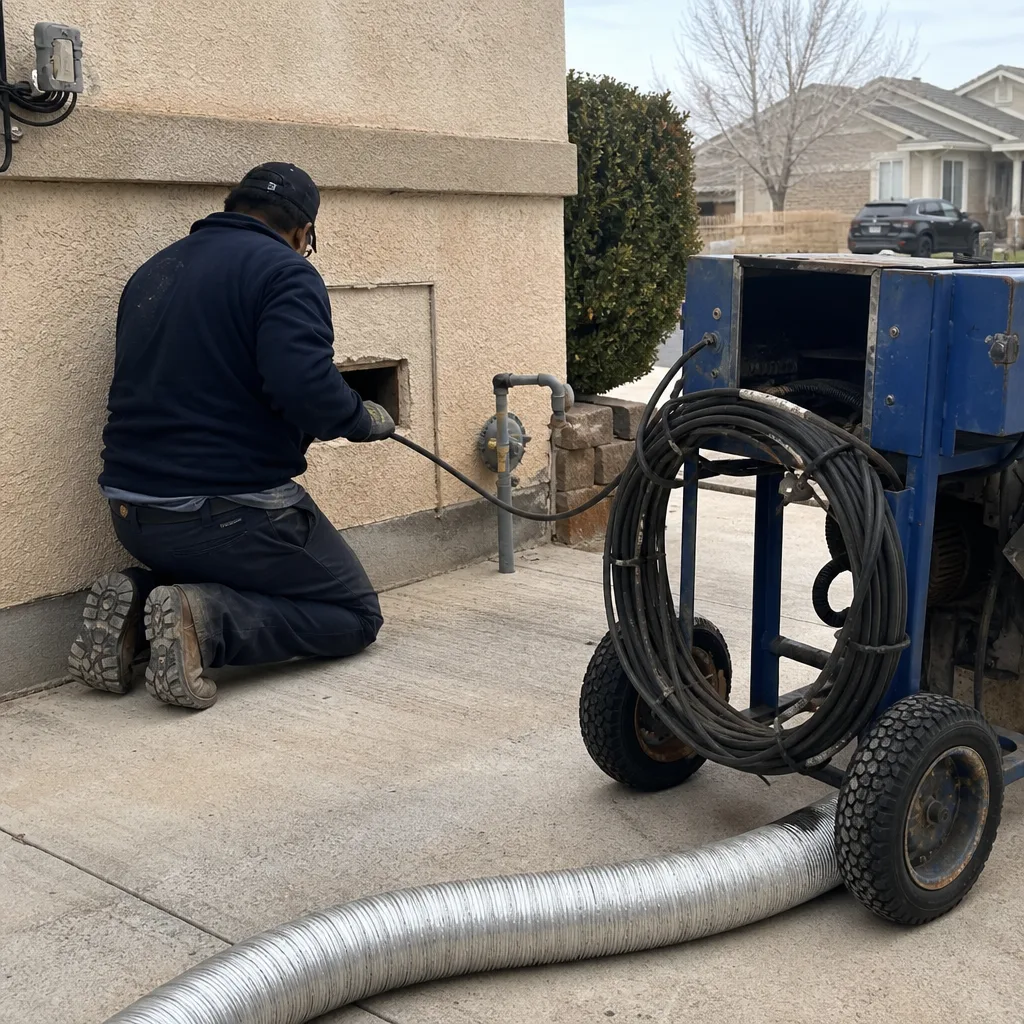 Before
 After
 Before
 After
When to Call a Professional
Some duct problems are obvious, and some are invisible until they’ve done damage. Call a professional when you see visible dust streaks at the registers, when the house smells musty every time the system starts up, or when a renovation has just wrapped and you’re not sure how much drywall dust found its way into the returns. Call when you’ve found a crushed or disconnected run, when the dryer is taking noticeably longer than it used to, or when you’re moving into an older Odessa home with no service history on the system. And call when you haven’t had the system inspected in years and don’t know its condition. Duct Cleaning Odessa offers free estimates in Odessa – call (833) 749-5958. We answer 24/7. Fast dispatch from 7am to 7pm, Sunday through Friday.
Frequently Asked Questions
Air duct cleaning in Odessa is priced per system, not per vent, and the written estimate sets the final price. We give a free estimate based on an inspection of the system rather than a vent count from the driveway, because the condition of the plenum, returns, and ductwork is what determines the scope. Call (833) 749-5958 for an exact quote – estimates are free.
A very low quote usually means a shop vacuum and a surface pass on the registers, without mechanical agitation of the full run or HEPA containment of the debris. The dust that stays in the ducts hasn’t gone anywhere, and a leaky return will keep drawing attic air into the system regardless. Ask any company you’re considering what equipment they use and whether they inspect the plenum and air handler before quoting. Call (833) 749-5958 for a scoped estimate.
Before-and-after photos of your own ducts, taken during the job, are the most direct verification. A legitimate cleaning also shows physical evidence at the end: the vacuum extracted debris, the runs were brushed, and the camera check shows clear interiors. Ask for the photos on any quote you receive. Call (833) 749-5958 to schedule an estimate.
Most Odessa homes benefit from an inspection every couple of years and a cleaning when the inspection shows meaningful accumulation. Homes near active oilfield operations, heavy truck routes, or a recent renovation often need a closer cadence, because caliche and silica dust load the system faster here than national guidance assumes. Call (833) 749-5958 to book an inspection-based estimate.
Yes. Air duct repair is part of our core service, so a failed joint, a crushed run, or a disconnected flex duct found during the inspection gets repaired while the system is open and accessible. Cleaning a leaky system without fixing the leak is a wasted job, so the two go together. Call (833) 749-5958 for a free estimate.
A full inspection covers the plenum, air handler cabinet, return boxes, accessible duct runs, register boots, and duct joints for integrity. It’s what sets the scope of the job, and it happens before the estimate is written. We don’t quote from the driveway without opening the system. Call (833) 749-5958 to schedule.
The Bottom Line
Air duct cleaning in Odessa isn’t a routine chore, because the conditions here aren’t routine. Caliche and silica dust, oilfield-adjacent particulates, low humidity, and near-year-round HVAC runtime load duct systems faster than the national average suggests. The right response is a system-level job: an inspection that opens the plenum, air handler, and returns; mechanical source removal with a rotary brush system and HEPA-rated vacuum; repair of any leakage found while the system is open; and before-and-after photos that show what was actually done. If you want that done right, our team runs professional-grade equipment from Rotobrush, Nikro, and Abatement Technologies, and we clean it and fix it in the same visit. Duct Cleaning Odessa offers free estimates across Odessa – call (833) 749-5958. We answer 24/7. Fast dispatch from 7am to 7pm, Sunday through Friday.
Written by the team at Duct Cleaning Odessa.