
Aprilaire Air Duct Repair in Odessa: A Homeowner’s Guide
You spent $600 to $1,200 on an Aprilaire whole-home air cleaner expecting your dust problem to shrink. Six months later the shelves still film over and nobody’s allergies feel better. The unit isn’t the problem – the duct system it’s bolted to usually is. Aprilaire equipment only delivers its rated performance when the ductwork around it is sealed and intact. A leaking duct network undermines a whole-home ventilator or media air cleaner the same way a cracked fuel line undermines a new engine. If you’d rather not crawl through this yourself, call (833) 749-5958.
Key Takeaways
- Aprilaire air cleaners and ventilators are rated to perform on a sealed, correctly pressurized duct system – leaks upstream or downstream change what they actually deliver.
- Attic-mounted installations, which are common in Odessa homes, put stress on the specific connection points where Aprilaire equipment ties into the ductwork.
- A duct network that leaks can pull more hot attic air into living space than the filter removes, working against the equipment you paid for.
- Repair work on an Aprilaire-integrated system is about restoring design airflow, not just taping over gaps.
- Ask any contractor whether they understand return-air pressure requirements before they touch your ducts.
Why does my Aprilaire air cleaner seem to do nothing?
Because a whole-home air cleaner can only clean the air that actually passes through it. When ducts leak, the system pulls air from wherever is easiest. In an attic-mounted setup, that’s often the attic itself – hot, dusty, and loaded with fiberglass particles.
Aprilaire media air cleaners and ventilators are rated for a specific airflow, measured in cubic feet per minute, through a specific pressure drop. Those ratings assume the ducts feeding and leaving the unit are tight. Add a few failed seams on the return side and the system draws part of its air from the attic instead of the house. The unit keeps running. The filter keeps trapping what passes through. But your living space keeps its dust, because much of the air you’re filtering never came from inside your home to begin with.
This is the part homeowners miss. People replace the filter, upgrade the media, even add a booster. The equipment was rarely undersized. The ductwork around it was never checked. In Odessa, where attics run hot for a large stretch of the year, those leaks matter more, because the air being pulled in is genuinely uncomfortable, not just slightly off.
How do Aprilaire units interact with duct pressure?
An Aprilaire ventilator or air cleaner sits in a delicate spot. Too much resistance upstream and airflow drops below what the unit was designed for. Too little, and it pulls the wrong air in.
Here’s how that plays out inside a real home:
- Return-air side leaks pull attic or unconditioned air into the return. The Aprilaire filter catches some of the dust, but the system is now running on air you didn’t want in the house.
- Supply-side leaks dump conditioned air into the attic. Your drum gets worked harder, and the room that should have received that air runs warm.
- Pressure imbalance throws off the balance between which rooms get more supply and which get less. Some rooms feel cold, some feel stuffy, and the Aprilaire unit reads that as irregular load.
- Fresh-air intake issues on a ventilator let it pull too little or too much outdoor air, depending on the pressure it sees downstream.
Spec-sheet numbers describe a bench test, not your house. On a leaky network, actual performance drifts from what Aprilaire printed, and the homeowner in Odessa is the one who notices.
Where do Aprilaire installations usually fail?
The failures we see most on Odessa attic-mounted systems are predictable. They cluster around the connections, not the duct runs themselves.
- Where the Aprilaire cabinet meets the main trunk. Factory transitions often use short flex connectors, and those can droop or crack under the weight of the cabinet over time.
- The return plenum drop. Long, unsupported drops flex with every cycle. Seams open at the boot where the plenum meets the ceiling.
- Fresh-air and exhaust penetrations on ventilators. Wall and roof penetrations move with temperature swings, and a gap that starts small grows into a real leak.
- Filter access doors. The service door on a media air cleaner is designed to open. The gasket behind it dries out and stops sealing.
- Takeoffs to individual rooms. Flex duct that runs hot in an attic loses its inner liner over time, and the run becomes a leak with a filter plate on the far end.
None of these are catastrophic on their own. Together, they add up to a system that looks intact and behaves like a sieve. For a closer look at how this affects the whole system, see our guide to air duct cleaning.
What does duct repair actually mean on an Aprilaire system?
It means restoring the ductwork to the airflow and pressure the Aprilaire unit was specified for. That’s more than sealing leaks – it’s putting the system back in balance.
On a standalone duct repair, a technician often works locally: fix the tear, support the sag, replace the boot. On an Aprilaire-integrated job, the technician has to think about the whole network at once. How much return air does the Aprilaire media air cleaner need to see its rated flow? What’s the static pressure downstream of the unit? Does the ductwork still deliver the design amount of air to the farthest bedroom?
Practical steps in a job like this usually include:
- Measuring static pressure at key points before and after repair, not eyeballing it.
- Sealing the Aprilaire cabinet transitions and filter-door gaskets as part of the repair, not as an afterthought.
- Rebalancing supply runs so each room sees the airflow the system was designed to deliver.
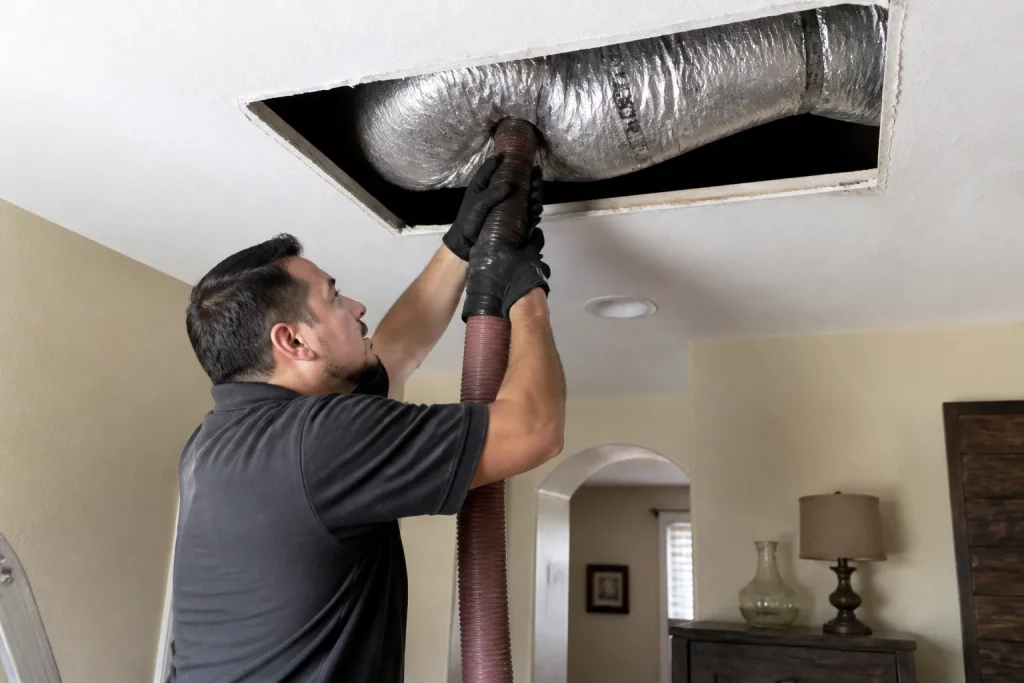
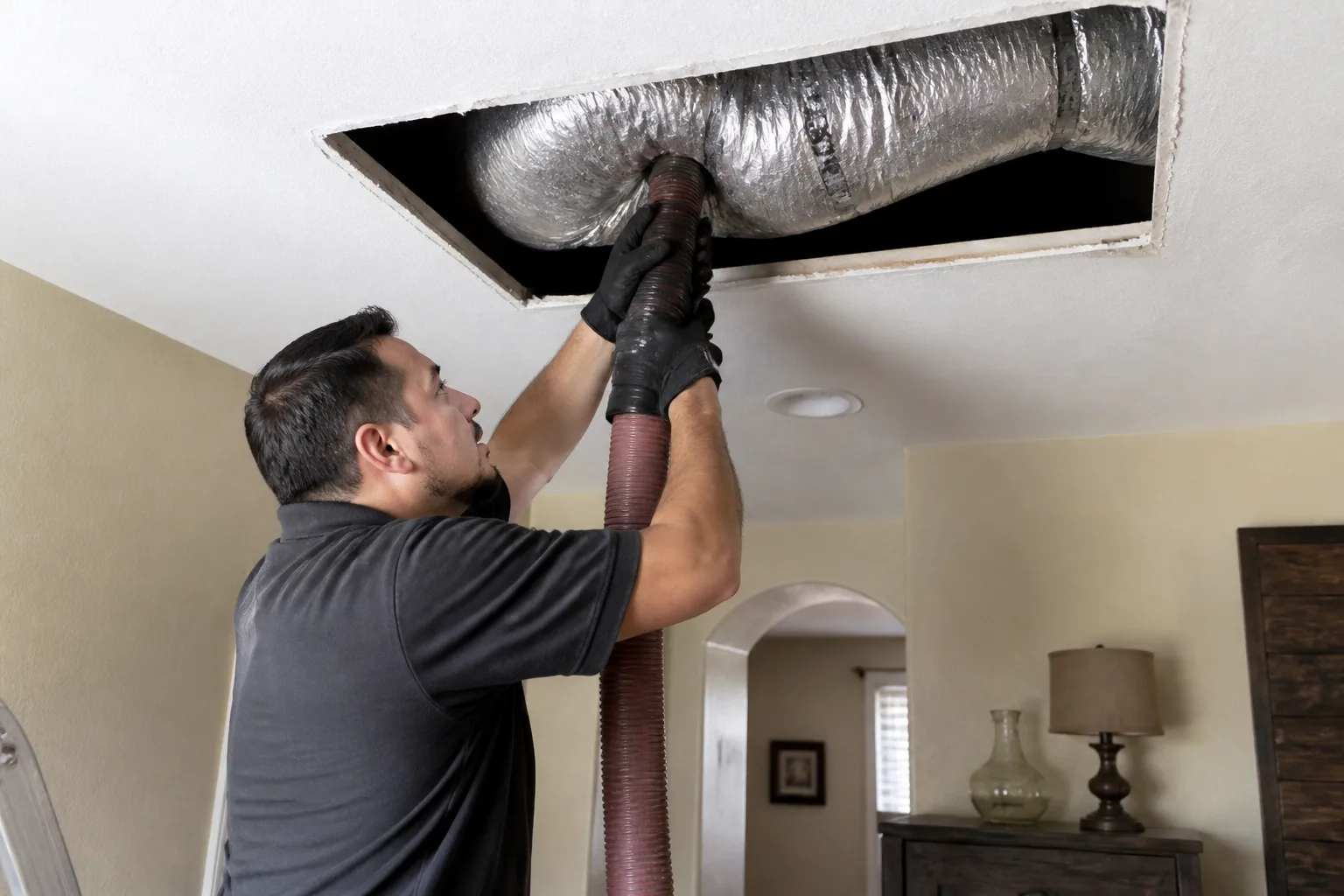
- Cleaning the interior while the ducts are open, using equipment like a Rotobrush rotary brush system and Nikro HEPA vacuum to contain debris rather than release it into the house.
- Re-checking the Aprilaire unit’s own readings once the network is tight.
That’s why an Aprilaire repair is a duct repair first and a filter change second. Repairing the network restores the equipment’s ability to do what you paid for.
Can a leaky duct network make an Aprilaire system pull in attic air?
Yes – and in a hot attic, that’s worse than it sounds. When returns leak, the system works harder to pull air from wherever is closest. In an attic-mounted system, that air is hot, dusty, and often loaded with insulation fibers. The Aprilaire unit filters what passes through, but the source air itself is the problem.
The net effect is a system that pulls in more unconditioned attic air than it removes contaminants from the living space. You’ve added an Aprilaire air cleaner to a leaky network and effectively guaranteed it spends part of its run filtering the attic. In Odessa, where summer attic temperatures climb well into the triple digits, that imbalance shows up as rooms that never quite cool and dust that comes back the day after you clean.
The fix isn’t to add a bigger filter. It’s to close the leaks so the unit draws only from living space, the way it was designed to.
When should you call a pro?
Call a trained technician when the work involves anything beyond a visible, accessible seam on a low run. Attic-mounted Aprilaire installations and sealed plenums are not a DIY job – the connections are often under load, the filter cabinet carries weight, and a bad seal can worsen the pressure imbalance you were trying to fix.
If you’re seeing dusty rooms, high utility bills, uneven cooling, or an Aprilaire unit that never seems to catch up, the duct network deserves a look. We can walk you through what a proper evaluation includes for your Odessa home. To round out the full system, look at dryer vent cleaning as well – lint buildup is a leading cause of house fires, and most homeowners never think about it until a dryer starts taking two cycles to finish a load.
What should you ask any contractor before they touch your Aprilaire ducts?
Ask whether they understand return-air pressure requirements on an Aprilaire system. If they hesitate, keep looking.
Aprilaire equipment is designed around specific airflow and pressure numbers. A contractor who doesn’t know what those mean on your model can “seal” a leak and make the system worse. Here’s what to ask:
- Do you measure static pressure before and after repair, or just seal and leave? A real answer includes a before-and-after reading.
- Do you know the return-air pressure requirements for my specific Aprilaire model? Not the general theory – your model.
- What professional equipment will you use to contain debris during the work, especially if you’re opening the cabinet? The answer should name real equipment – Rotobrush and Nikro, Abatement Technologies – not a shop vac.
- Are you comfortable with Honeywell or Aprilaire controls, or do you only handle the ducts?
- Will you restore design airflow and rebalance supply runs, or just patch the leak I pointed at?
Those five questions separate contractors who understand whole-home IAQ equipment from the ones who specialize in dryer vents and duct cleaning only.
The Bottom Line
An Aprilaire whole-home air cleaner is worth what you paid for it – as long as the ductwork it’s connected to is sealed and correctly pressurized. When the network leaks, the unit works against the house instead of for it. Attic-mounted systems common in Odessa are especially exposed to the specific connection points that fail first: cabinet transitions, plenum drops, fresh-air penetrations, and filter-door gaskets. Repair on an Aprilaire system means more than sealing – it means restoring design airflow so the equipment can deliver its rated performance.
If you’re in Odessa and need help, Duct Cleaning Odessa offers free estimates – call (833) 749-5958. We answer 24/7. Fast dispatch from 7am to 7pm, Sunday through Friday. We work with professional-grade Rotobrush and Nikro equipment and know Aprilaire and Honeywell systems from the inside out. One flat price per system is agreed before work starts, and you get before-and-after photos of your own ducts – not a stock image of someone else’s.
Frequently Asked Questions
Typical Aprilaire-connected duct repair in Odessa runs $350 to $900 depending on how many connection points need resealing and whether airflow rebalancing is required. Larger jobs that involve cabinet transitions, plenum drops, and full-system rebalancing can run higher. Call (833) 749-5958 for an exact quote – estimates are free.
Cheap quotes usually skip the pressure measurements, seal only the visible leaks, and leave the Aprilaire unit running on the same imbalanced network it started on. A real repair includes testing static pressure before and after, then restoring design airflow. Call (833) 749-5958 to talk through what a proper evaluation covers.
Ask for before-and-after photos of your own ducts and the pressure readings taken at each stage. On an Aprilaire-integrated job, the technician should show you the numbers – what was the static pressure at the Aprilaire cabinet before, and what is it after. Call (833) 749-5958 and we’ll walk you through what the readings should look like.
Every 3 to 5 years as a general check, and sooner if you notice dust returning quickly, uneven cooling in certain rooms, or rising utility bills. In Odessa’s hot attic conditions, we recommend an inspection anytime the Aprilaire unit seems to underperform. Call (833) 749-5958 to book a free estimate.
If the filter is the only thing that’s dirty and everything else checks out, a filter change is enough. If dust keeps returning, rooms cool unevenly, or the Aprilaire unit never keeps up, the duct network needs a look first. Call (833) 749-5958 – we can help you tell the difference.
Written by the team at Duct Cleaning Odessa.
Need Air Duct Cleaning Help?
Call Duct Cleaning Odessa - licensed & insured, here with fast help in Odessa.
(833) 749-5958